
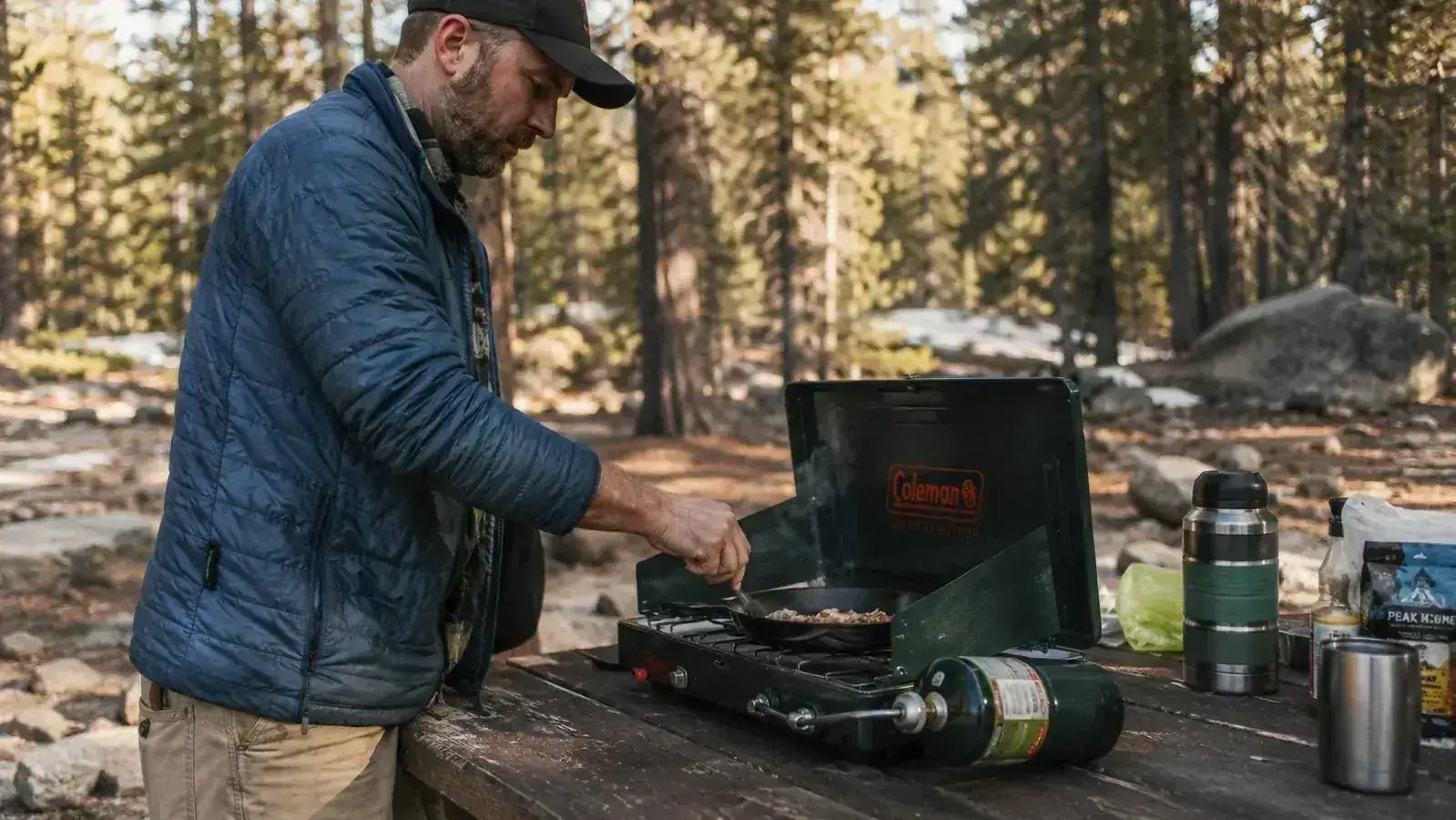
The summer I bought the Coleman Triton, I had just spent a miserable weekend at Eleven Mile Reservoir juggling a single-burner backpacking stove for a group of five people. Coffee first, then oatmeal, then the eggs, then the sausage, one item at a time while everyone stood around staring at me. By Sunday morning my camp partner Dave said, 'Next trip we're getting a real stove.' He was right. I picked up the Triton that fall and it has been in my truck on every camping trip since. That is about 40 trips over four years across Colorado, Utah, and New Mexico.
I want to give you the long-term picture here, not just a first-week impression. The Triton has some genuine strengths that hold up over time, and it has two failure points that reviewers almost never mention. Both matter if you are planning to cook real food in wind or at altitude. I'll cover all of it.
The Quick Verdict
The Coleman Triton is the best value two-burner propane stove for car campers who want real cooking performance without spending premium prices on a Camp Chef. Wind and altitude each chip away at output, but neither kills the stove. After 40+ trips it still lights first try every time.
Amazon Check Today's Price →If you are cooking for more than two people at camp, one burner is the wrong answer.
The Coleman Triton 2-burner has 3,584 Amazon ratings averaging 4.7 stars. Check today's price before it moves.
Amazon Check Today's Price on Amazon →How I Have Used It
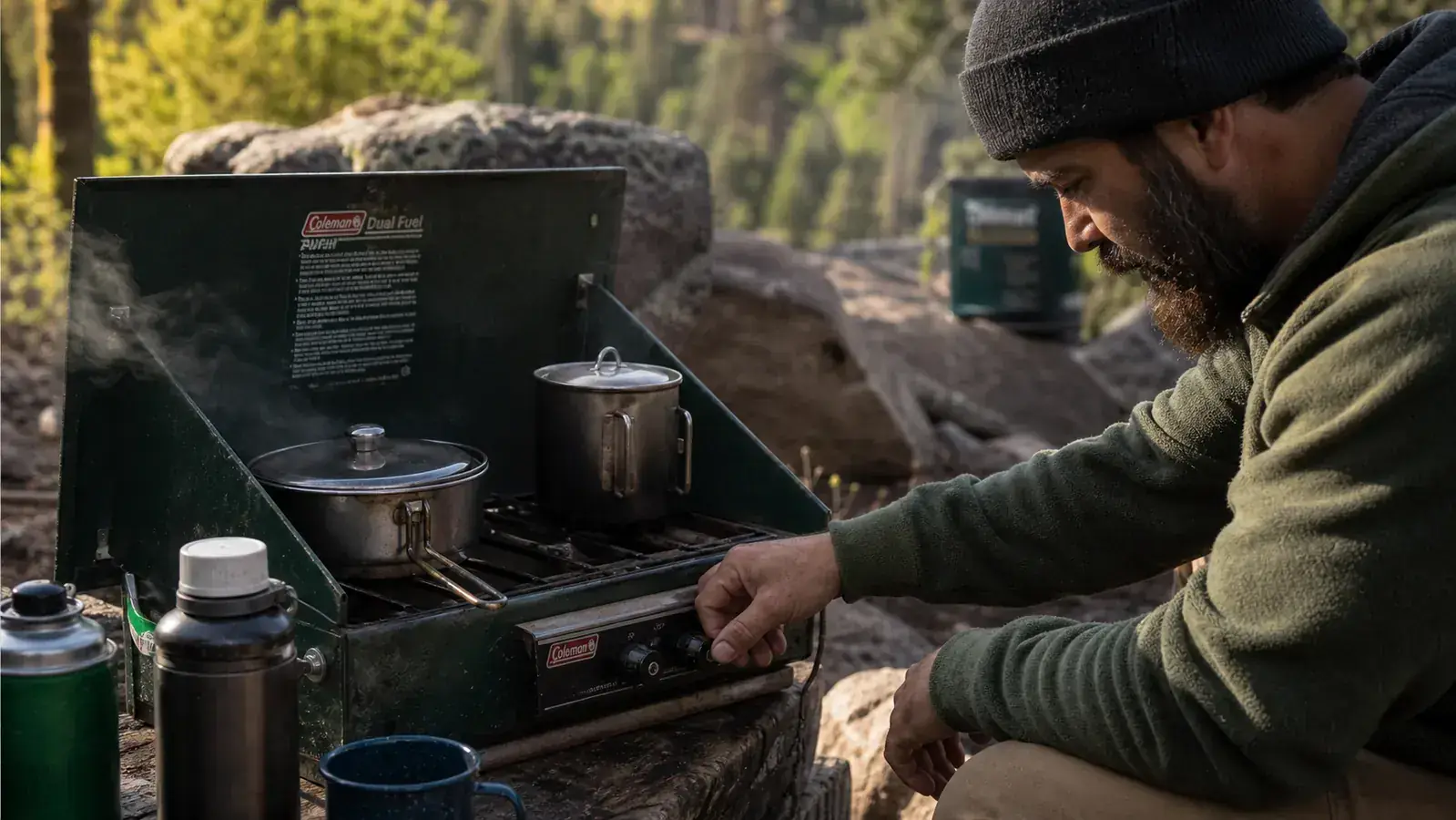
I am a car camper and occasional dispersed-camping guy. My typical setup is a truck camp at a developed site or a flat pullout at 8,000 to 10,500 feet in Colorado. I am usually cooking for three to six people, and the menu is not trail mix. I am talking bacon and eggs in the morning, rehydrated beans with a saute, pasta with a sauce, and occasionally an elk steak that needs real heat. The Triton handles all of that.
I run it on 1-pound green Coleman cylinders for weekend trips and on a 5-pound tank with a hose adapter for longer stays. I have used it in temperatures from 28 degrees at a September site in the San Juan Mountains down to a July morning at 9,200 feet on the Grand Mesa. I have cooked in calm air and in 25 mph wind. I have dropped it once onto gravel from a tailgate, set the carry bag on a wet log more times than I can count, and stored it in an unconditioned garage through three Colorado winters. It still works exactly the way it did on the first trip.
Burner Performance and Heat Control
Each burner on the Triton puts out 10,000 BTU. That is plenty for camp cooking. A cast iron skillet will be properly hot in about four minutes at 9,000 feet, maybe three at lower elevations. The knobs are stiff enough to give you real control across the range from a bare simmer to a hard boil, which matters more than most people realize. I use a low simmer for refried beans and oatmeal constantly. It holds a true low flame without the burner dying out on me, which is something my old single-burner canister stove could not manage.
The push-and-turn ignition has lit first try on every single trip I can remember. I keep a butane lighter in the kit anyway as a backup, but I have not needed it. The igniter sparks even when the knobs and stove body are cold from overnight, which matters more than you would think at altitude in September when it is 34 degrees at 7 AM.
One thing worth knowing: the two burners are not identically sized. One is slightly larger. I put the cast iron on the bigger burner and the pot on the smaller one. Once you figure out your own preferred setup, you stop thinking about it.
Wind Performance: The Real Limitation
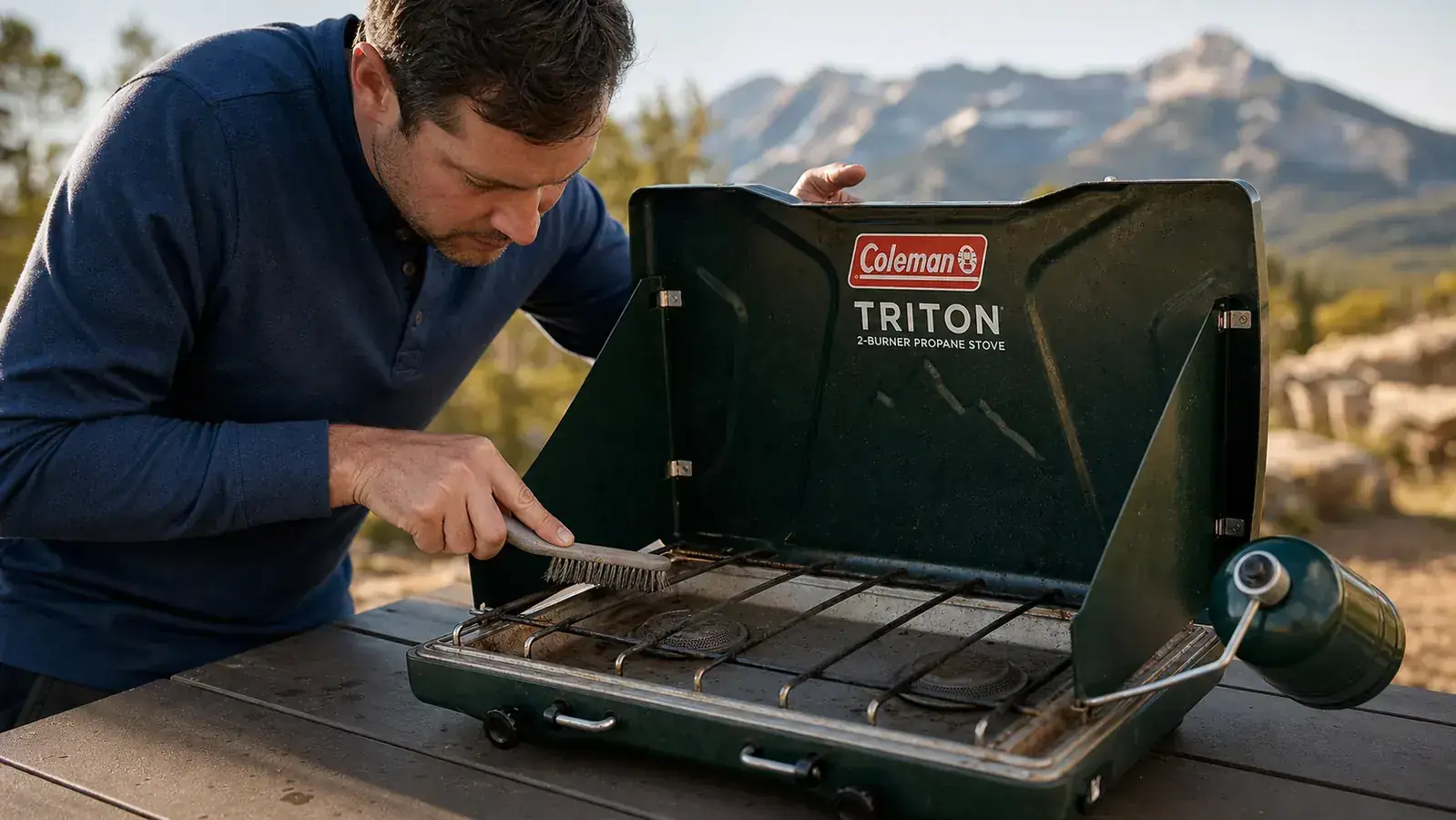
This is the part that does not show up in most reviews because most reviewers test the stove in a backyard or at a calm campsite. In real Colorado wind, the Triton loses heat. The fold-up windscreens on the sides help some, but they do not close off the front and back. In a sustained crosswind above 15 mph, boil time roughly doubles. That is not unique to this stove. It is physics. But it is worth knowing.
My workaround is to position the stove so the long side faces the wind, use the side panels as a partial block, and angle my body to break some of the airflow. At campsites with a table, I put the stove in the corner where two windbreaks meet. On exposed spots I sometimes drape a reflective foil windscreen from the camp kitchen kit around three sides. In those conditions the Triton performs fine. The stove is not the problem. The setup is the solution.
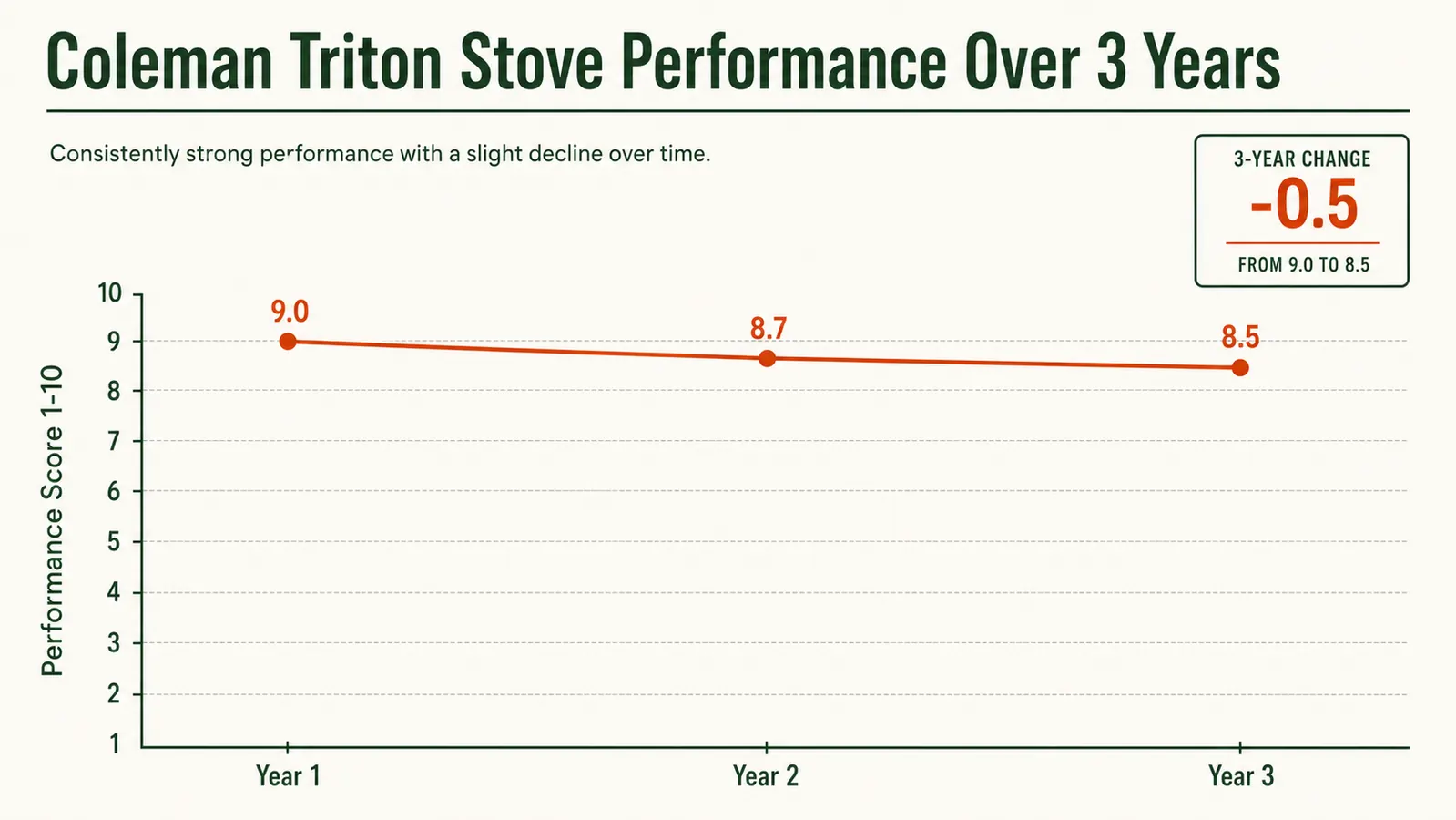
After four years and 40 camping trips, the Triton still lights first try in 28 degree mornings at 9,000 feet. That is the thing I keep coming back to: reliable tools get used, unreliable ones stay home.
Altitude Performance
Propane stoves lose output at altitude because of lower air pressure, and they also lose output when the tank gets cold because liquid propane has lower vapor pressure at low temperatures. At 10,000 feet on a 40-degree morning, you will notice maybe a 15 to 20 percent reduction in effective heat compared to sea-level cooking at 70 degrees. The Triton handles this better than canister stoves in my experience, because you can run it off a larger tank that stays warmer inside an insulated tote or simply warmer in relative terms because it is bigger and slower to cool. On very cold mornings I sit the 5-pound tank in a small cooler of warm water for a few minutes before cooking. That trick works regardless of stove brand.
If you are camping mostly at low elevation in mild temperatures, altitude is a non-issue for you. If you are regularly camping above 9,000 feet, know what to expect and have a workaround ready.
Build Quality and Long-Term Durability
The Triton body is coated steel. It is not the thickest gauge metal you will find, but it is consistent with what the price point delivers. The hinges on the side windscreens have held up without loosening. The drip tray under the grates lifts out for cleaning and has not warped, which I appreciate because warped drip trays are a common complaint with cheaper two-burner stoves.
The grates themselves are porcelain-coated cast iron. They will chip if you drop them onto hard surfaces, and I have a chip on one corner from that tailgate drop I mentioned. It does not affect function. The coating around the chip has not continued to flake. Small wins.
After four years the ignition still works. That is the primary long-term question with any camp stove igniter, because they are the first thing to fail. Coleman's igniter on the Triton seems to be better specified than what I saw on the older classic stove design. Four years of consistent first-light performance earns real credit.
Packability and Setup
The Triton folds flat. When closed it is about 19 inches wide, 13 inches deep, and 4 inches tall. It fits in the back of my 4Runner under the cargo shelf alongside a camp kitchen tote and a cooler without having to play Tetris. For car camping, that footprint is totally manageable.
Setup is five seconds. Open the lid, pull up the back panel, connect the hose or screw in a canister, turn and push, done. Teardown takes maybe a minute once the grates cool. If you have been dealing with a complicated backpacking stove with fiddly windscreens and canister threads, the Triton will feel like a quality-of-life upgrade.
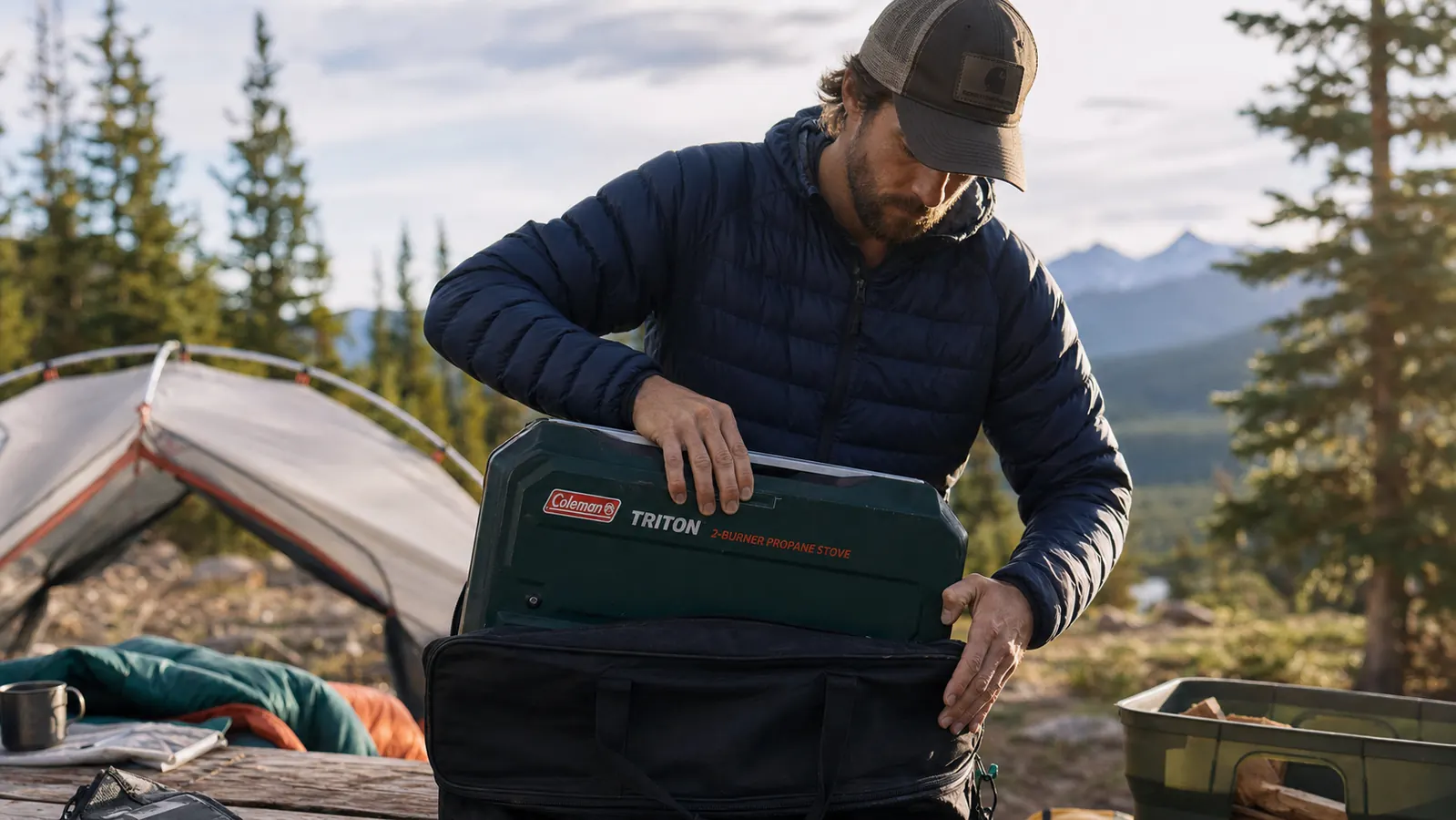
One note on the carry case: Coleman sells a bag for it separately. It is worth getting. The stove's latches keep it closed but a bag protects the grates and knobs from banging around in the truck bed. I picked one up after year one and wish I had bought it with the stove.
What I Liked
- Push-and-turn igniter has lit first try on every single trip over four years, including sub-freezing mornings
- 10,000 BTU per burner is enough heat for a cast iron skillet and a full pasta pot running simultaneously
- True low-simmer control without the flame dying, which most cheap camp stoves cannot manage
- Porcelain-coated cast iron grates hold real cookware, including a 10-inch cast iron skillet and a 5-quart Dutch oven
- Folds flat to a manageable 19x13x4 inch package for truck or SUV storage
- Compatible with both 1-pound green canisters and larger tanks via hose adapter
Where It Falls Short
- Side windscreens do not close off front and rear, so sustained crosswind above 15 mph cuts output noticeably
- Grates chip if dropped on hard surfaces, though function is not affected
- No built-in thermometer or pressure gauge, so you are guessing at canister fuel remaining
- Carry bag sold separately, which should really be included at this price point
- Not designed for backpacking; the 4.6-pound body weight means this lives in your car
Alternatives I Have Considered
The two stoves that come up most often as alternatives are the Camp Chef Everest 2X and the Coleman Classic (older 2-burner design). The Camp Chef runs 20,000 BTU per burner, which is genuinely more heat, and it handles wind better because of its burner design. It also costs roughly twice as much. For the kind of car camping I do, the extra BTU is overkill most of the time. If you are regularly cooking wok-style at high heat or frying fish for a large group, the Camp Chef is worth the money. If you are making eggs and pasta and the occasional steak, the Triton is plenty and you keep the extra money in your pocket.
The older Coleman Classic 2-burner is cheaper and has been around forever. The main difference is that the Triton has a newer igniter design and slightly cleaner flame control. I have used both. For a new purchase I would pick the Triton. If you already own a functioning Classic, there is no reason to switch.
For a deeper side-by-side breakdown, see my full comparison of the Triton against the Camp Chef at Coleman Triton vs Camp Chef Stove. And if you are still deciding whether two burners is actually worth it over a single burner setup, read 10 Reasons a Two-Burner Camp Stove Beats a Single Burner Every Time.
Who This Is For
The Coleman Triton is built for the car camper who wants to cook real food. If your camp meals involve anything beyond boiling water for instant oatmeal, you need two burners. The Triton gives you that at a price that does not sting. It works well for groups of two to six people, handles a full-size skillet and a pasta pot simultaneously, and will last years if you give it basic care. It is also a solid choice for people who camp at established campgrounds with picnic tables rather than deep backcountry sites where weight is everything.
Who Should Skip It
If you are camping above treeline regularly in Colorado or Wyoming, where wind is relentless, the Triton will frustrate you unless you build a windbreak into your kitchen setup. In that case, seriously look at the Camp Chef Everest, which has a ring burner design that handles crosswind better. Also skip this stove if you are backpacking. It weighs 4.6 pounds without fuel and does not pack into a bag. For anything where you are carrying gear on your back, you want a canister stove. The Triton lives in vehicles.
Four years, 40 trips, and the igniter still lights first try. Not many tools earn that.
The Coleman Triton 2-Burner Propane Stove is rated 4.7 stars from 3,584 campers on Amazon. If you cook real food at camp, two burners is not optional. Check today's price below.
Amazon Check Today's Price on Amazon →